

DISPLAYED CLEARLY ON THE ARCH OF TITUS, WHICH CELBRATED THE DESTRUCTION OF JERUSALEM IN 70 CE BY ROME, ONE CAN SEE THE IMAGE OF THE MENORAH AND OTHER ITEMS TAKEN FROM THE TEMPLE. OVER A MILLION JEWS WERE EITHER SLAIN OR TAKEN INTO SLAVERY BY THE ROMAN EMPIRE WHEN THE GREAT REVOLT FAILED.

.jpg/500px-Monnaie_-_Prutah%2C_bronze%2C_J%C3%A9rusalem%2C_Jud%C3%A9e%2C_Mattathias_Antigonos_-_btv1b8480202s_(1_of_2).jpg)
i. https://en.wikipedia.org/wiki/Terumah_(parashah)
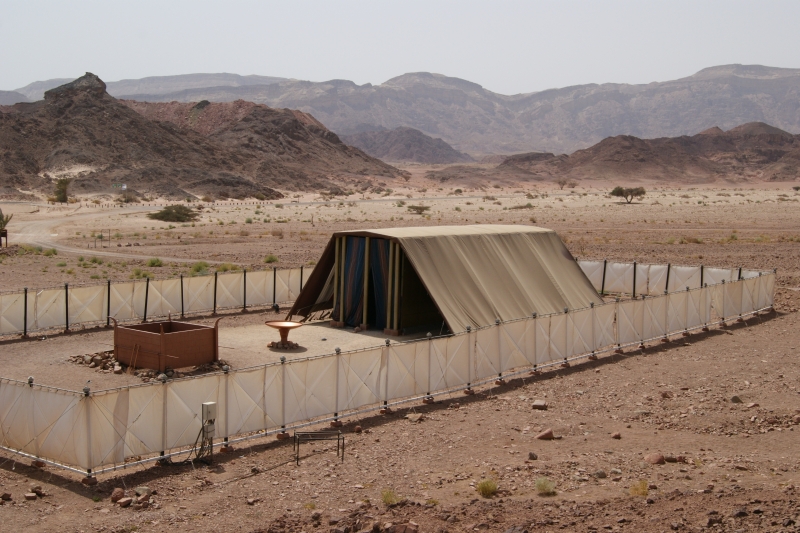
ii. https://upload.wikimedia.org/wikipedia/commons/1/18/Stiftshuette_Modell_Timnapark.jpg
SHEMOT 25
Now Adonai spoke to Moshe, saying:
Speak to the Children of Israel,
that they may take me a donated-contribution;
from every person whose heart makes-them-willing, you are to take my
contribution. And this is the contribution that you are to accept from them:
· gold, silver, and bronze,
· blue-violet, purple, and worm-scarlet [yarns], linen, and goats’-hair,
· rams’ skins dyed-orange,
· tanned-leather skins,
· acacia wood,
· oil for lighting,
· spices for oil of anointing and for fragrant smokey-incense,
· onyx stones and precious gems for setting
for the efod and for the chest-plate.
Let them make me a Mikash/Holy-Shrine,
that I may dwell amidst them. Exactly as
I grant you to see,
the building-pattern of the Mishkan/Dwelling and the building-pattern of
all its implements, that’s how you are
to make it.
They are to make an Aron of
acacia wood,
two amot and a half its length,
an amah and a half its width,
and an amah and a half its height.
You are to overlay it with pure gold,
inside and outside you are to overlay it,
and are to make upon it a rim of gold all around.
You are to cast for it four rings of
gold
and are to put them upon its four feet,
with two rings on its one flank
and two rings on its second flank.
You are to make poles of acacia wood
and are to overlay them with gold
and are to bring the poles into the
rings on the flanks of the Aron,
to carry the Aron by means of them.
In the rings of the Aron are
the poles to remain;
they are not to be removed from it.
And you are to put in the Aron
the Testimony that I will give you.
You are to make a kaporet/atonement-cover of pure gold,
two cubits and a half its length
and a cubit and a half its width.
You are to make two keruvim/winged-sphinxes
of gold;
of hammered-work are you to make them,
at the two ends of the atonement-cover.
Make one sphinx at the end here
and one sphinx at the end here;
from the atonement-cover you are to make the two sphinxes,
at its two ends.
And the sphinxes are to be spreading
[their] wings upward
with their wings sheltering the atonement-cover,
their faces, each-one toward the other;
toward the atonement-cover are the sphinxes’ faces to be.
You are to put the atonement-cover on the Aron,
above it,
and in the Aron you are to put
the Testimony that I give you.
I will appoint-meeting with you there
and I will speak with you
from above the atonement-cover,
from between the sphinxes that are on the Aron of Testimony—
all that I command you
concerning the Children of Israel.

Why use plain Acacia wood for the
Mishkan?
So much else in this portable temple
is made of the ost expensive materials: Gold, gems, fine fabrics. What’s with
the Acacia wood?
Answer 1: Because it was special wood and had been set aside by Jacob himself!
Rashi (Rabbi Shlomo Yitzhaki, 10th
century France) on Exodus 25:5:3
ועצי
שטים
AND ACACIA WOOD — And from where did they get this in the wilderness? Rabbi
Tanchuma explained it thus: Our father Jacob foresaw by the gift of the Holy
Spirit that Israel would build a Tabernacle in the wilderness: he therefore
brought cedars ( here called acacia) to Egypt and planted them there, and
instructed his children to take these with them when they would leave Egypt.
So
Rashi believes that the wood was a type of cedar, and cedar is fragrant,
marvelous stuff. Cedar
is seen as a dignified wood and is a premium building material even today. In
fact, King Solomon builds much of the interior of his amazing palace out of cedar- his throne room is recorded as cedar from
“floor to floor”. Solomon also builds
much of the first Temple in Jerusalem
(which would take the place of the Mishkan around the year 980 BCE) with cedar.

Answer 2: Because it was
common wood and could be found locally.
Ibn Ezra (Rabbi Abraham ibn Ezra, 11th
century Spain) on Exodus 25:5:3
ועצי שטים. ...כי היה סמוך אל הר סיני יער עצי שטים...
...there was a forest of Acacia
trees near Mt. Sinai, [and they used that for the Mishkan].
ועצי שטים, “and
acacia wood.” ...There were some forests which they called Shee-teem in the wilderness
from which the Israelites were able to cut boards. This is also why we read in
Joshua 2,1 that “Joshua sent out spies from (the forest around
Shee’teem)."
Answer
3: Because it
was the perfect stuff for the job
Michael Schlesinger and Catherine
Walters, The Biblical Garden Blog (2016):
Several species of acacia were common and
accessible on the Sinai peninsula, but only Acacia
Raddiana is suitable for construction. This
thorny tree has an impressive umbrella shape: a single trunk with a broad and flat
crown. The bark is brown-reddish and the leaves are small to conserve water.
Highly resistant to drought, it grows deep roots and
uses water stores that other plants cannot reach. Because the tree grows slowly, the
wood is hard and dense, resistant to water and insect damage. Acacia wood is
beautiful and nearly indestructible, well-suited
for carrying the Mishkan as the
Israelites sojourned in the wilderness and moved on
into Canaan. https://www.templesinairi.org/biblical-garden-blog/a-tree-suitable-for-gods-presence

Answer 4: Because of what
it teaches us. Rabbi Charlie Schwartz wrote (2010)“In the
eyes of the midrash, acacia wood is a humble, inexpensive wood. God commanded
the Mishkan to be made of acacia to teach principles of derekh eretz —
that is, the traits one should embody, in this case humility.” Rabbi Ishmael bar Rav Nachman taught the
rabbinic principle Derekh Eretz kadmah Le’Torah, that one must have Derek Eretz (basic decency
and humility) before one can learn Torah.
The simple wood that forms the basic structure of the ark, table of
showbread and other parts of the tabernacle has to be in place first before the
glorious gold, silver, and rare fabrics
added to it. So too, before one learns all the glorious wisdom
contained in Torah, one must have a
foundation of decency and humility.”
What do we learn from the fact that the broken tablets were placed in the Ark alongside the whole ones?

No comments:
Post a Comment